
Kuwait Cultural Taboos – What Every Visitor Should Know Before Traveling
 By Axel Donovan
Kuwait is a nation that combines modern development with its cultural traditions in the best way possible. While it welcomes travelers from all over the world, there are certain Kuwait cultural taboos that every visitor should know to avoid misunderstandings or unintentional disrespect. These customs are not only to be used as a way of maintaining your respect but also to have a good and enriching experience during the exploration of this interesting Gulf country.
You will need to apply for a Kuwait eVisa via Kuwait Immigration Services before planning your visit—an official, fast, and secure means of entering the country without any hassle. As soon as you are accepted, you will be in a position to explore the culture, history, and hospitality of Kuwait with a lot of confidence.
- 1. Understanding Kuwaiti Culture
- 2. Religious and Moral Taboos
- 3. Dress Code and Public Appearance
- 4. Social Etiquette and Greetings
- 5. Gender Interaction Taboos
- 6. Food and Dining Etiquette
- 7. Photography and Privacy
- 8. Workplace and Business Etiquette
- 9. Legal and Public Conduct Taboos
- 10. Cultural Sensitivity During Ramadan
- 11. Tips for Tourists and Expats
- 12. How Kuwait Immigration Services Can Help
- 13. Conclusion
1. Understanding Kuwaiti Culture
The culture of Kuwait is very much affected by the traditional Arabic values and Islam. Daily life revolves around respect, family, and hospitality. These values shape social norms and legal expectations that guide what is considered appropriate behavior in public spaces.
It is necessary to know about Kuwaiti cultural taboos when you are visiting the country as a tourist, a businessperson, or a long-term worker. The Kuwaiti people tend to be friendly and polite; however, they cherish modesty, discretion, and respect for their religion more than anything.
2. Religious and Moral Taboos
Religion plays a central role in Kuwaiti society. Since the religion is the state religion, there are a number of moral boundaries that are established on the basis of the religious standpoints.
- Public criticism or disrespectful discussion of Islam is strongly discouraged and may have legal consequences. Do not argue about religion or the Prophet Muhammad.
- During Ramadan, do not consume, drink, or smoke in front of the eyes of daylight; it is considered highly disrespectful.
- Alcohol is strictly prohibited. Alcohol is illegal in Kuwait, and the sale, purchase, possession, and consumption of alcohol are prohibited by law. It is also against the law to import it into the country.
- Avoid public proselytizing or distributing religious materials without authorization, as public religious promotion is restricted. Kuwait is very protective of its Islamic heritage.
- Respect mosques and religious spaces. Always remove your shoes before entering and dress modestly.
Breaking these moral boundaries is an offense that is offensive and, in certain instances, it is subject to the law.
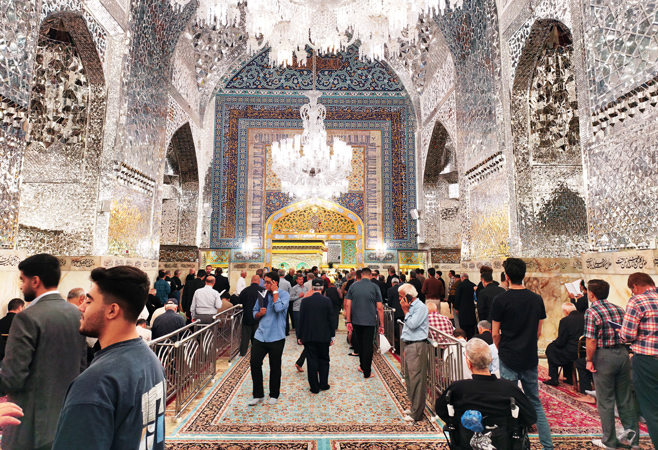 Respect mosques and religious spaces
3. Dress Code and Public Appearance
Although Kuwait is modern, it is conservative compared to Western countries. Adherence to the local dress code is among the most significant Kuwaiti cultural taboos for visitors.
- For men: Wearing sleeveless shirts or very short shorts in public places is generally discouraged, especially in traditional or official settings.
- For women: Do not wear short skirts, tight clothes, or exposed tops. You do not wear a headscarf but dress decently, and it will help you gain goodwill.
- At the beach or resort: Western-style swimwear is acceptable at private resorts, hotel pools, and beach clubs, while modest attire is expected at public beaches. Should not put on bikinis or other revealing attire at public beaches.
- Public behavior: Avoid excessive displays of affection (kissing, hugging, holding hands) in public. Such actions are considered inappropriate.
Being modest demonstrates that you are aware and knowledgeable of Kuwaiti social norms.
4. Social Etiquette and Greetings
Kuwaitis are extremely hospitable, but their social customs are formal and rooted in respect.
- Greet others with “As-salamu alaykum” (peace be upon you) — it’s a polite and common Arabic greeting.
- Use your right hand for handshakes and exchanging items; the left hand is considered impolite.
- Avoid touching or shaking hands with someone of the opposite gender unless they initiate it.
- Always greet the oldest person first in a group — it’s a sign of respect.
- Don’t interrupt or raise your voice during a conversation.
Following these customs will help you make a positive impression and avoid offending your hosts.
 Dress decently in Kuwait
5. Gender Interaction Taboos
Interactions between men and women in public settings are more restricted than in Western cultures.
- Men should not start conversations with Kuwaiti women they don’t know.
- One should not ask personal questions concerning the wife, sister or mother of a person; this is one of the most sensitive Kuwait cultural taboos.
- The family sections, which provide privacy, are also found in cafes, malls, or restaurants. These are the areas to be selected at all times when you are in the company of women or children.
- Physical contact between unrelated men and women is discouraged.
These are the limits that you should also respect to handle social interactions gracefully and respectfully.
 Greet others with “As-salamu alaykum”
6. Food and Dining Etiquette
Eating in Kuwait is a nice experience, yet there are several Kuwaiti cultural taboos regarding food:
- Never eat pork — it is forbidden under Islamic law.
- Avoid alcohol entirely, even for special occasions.
- Always use your right hand when eating or passing food.
- Wait for the host to invite you to start eating.
- Traditionally, leaving a small amount of food may indicate satisfaction, though modern dining customs are generally more flexible — finishing everything may be seen as rude.
- Avoid discussing politics or religion at the table.
It is customary to remove your shoes when entering a Kuwaiti home, unless the host indicates otherwise when visiting.
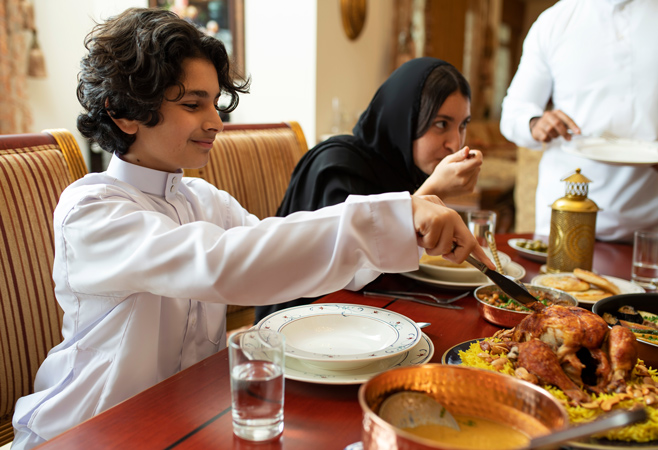 Kuwaiti culture regarding food
7. Photography and Privacy
Kuwaitis attach great importance to privacy. One of the gravest Kuwait cultural taboos would be taking photos without permission.
- Do not ever take photographs of Kuwaiti women, families, or children without their express permission.
- Avoid photographing military facilities, police officers, and government buildings. Photography of mosques may be allowed in some cases, but permission should always be sought first
- Avoid using drones or professional cameras in public without a license.
Always ask politely before taking any photo that includes locals. A simple “May I take your picture?” (in Arabic: “Momkin asawrek?”) goes a long way.
8. Workplace and Business Etiquette
Cultural respect and hierarchy are of significance in the workplace.
- Be punctual, but don’t be surprised if meetings start later than planned — flexibility is normal.
- Greet everyone respectfully, starting with senior members.
- Never refuse Arabic coffee (gahwa) — it’s a traditional gesture of hospitality.
- Avoid political or religious discussions in the workplace.
- Dress formally; modesty and professionalism go hand in hand in Kuwaiti offices.
It is also worthwhile to develop trust and patience instead of urging business culture to deliver quick outcomes.
9. Legal and Public Conduct Taboos
Certain activities that would be treated as trifles in other nations will have severe repercussions in Kuwait.
- Drugs and alcohol are strictly illegal — even possession can result in imprisonment.
- Swearing or offensive gestures in public are criminal offenses.
- Same-sex relationships are legally restricted, and public displays of intimacy—regardless of gender—are prohibited by law
- Criticizing the Emir, the royal family, or government is illegal.
- Avoid political discussions or protests in any form.
It is not only a question of etiquette but also one of safety and legality to respect local laws.
10. Cultural Sensitivity During Ramadan
Visitors are particularly expected to be especially careful during the sacred month of Ramadan:
- Eating, drinking, or smoking should be avoided during the daytime when in public places.
- Wear more conservative clothes.
- Loud music and public entertainment are generally discouraged during daylight hours in Ramadan
- Once the sun has set, gather together with locals to have the "Iftar" dinner—a warm and grateful reflection of food sharing and thanksgiving.
The observance of Ramadan traditions is very respectful to the traditions and religion of Kuwait.
11. Tips for Tourists and Expats
- Learn a few Arabic phrases — locals appreciate the effort.
- Be patient and polite in all interactions.
- If you’re unsure about something, observe what locals do or ask politely.
- Always show gratitude when offered food, coffee, or gifts.
Knowledge of Kuwaiti cultural taboos can make you relate more with others and will enhance your traveling experience.
12. How Kuwait Immigration Services Can Help
In case you intend to travel to Kuwait to conduct business or to travel there as a tourist or as a family member, you will require a valid visa. Applying for a Kuwait eVisa is the easiest and safest approach to obtain it through Kuwait Immigration Services.
- Convenient online application process.
- Fast approval time.
- Assistance with travel guidelines and visa requirements.
Their professional staff guarantees that tourists come to Kuwait without any problems related to legal issues and without any concerns about such matters; they explore this country in good faith.
13. Conclusion
Kuwait is a hospitable, historical, and heartfelt nation. Yet it has good cultural values too, which are based on religion and tradition. By understanding and respecting Kuwait's cultural taboos, you’ll not only avoid misunderstandings but also earn the warmth and trust of the local people.
From the dress code to the greetings, all the signs of respect will add value to your experience in this exotic Gulf country. Before you pack your bags, be sure to apply for your Kuwait eVisa at Kuwait Immigration Services, which is your gateway to a safe, respectful, and enlightening trip through the traditions of Kuwait.
Related Articles
- Interesting Facts About Kuwait You Should Know Before Visiting
- Photography Spots in Kuwait – Top Places for Stunning Photos
- Yacht Trip in Kuwait – A Luxury Experience on the Arabian Gulf
- Camping in Kuwait Desert – The Ultimate Guide to a Desert Adventure
- Camel Riding in Kuwait – A Complete Desert Experience Guide
- Fine Dining in Kuwait – A Guide to Luxury Culinary Experiences
- Autumn in Kuwait – Weather, Places to Visit, and Travel Tips
- Winter in Kuwait – Weather, Best Places to Visit, and Travel Tips
- Kuwait Summer – Weather, Travel Tips, and Things to Do
- Spring in Kuwait – Weather, Best Places to Visit, and Travel Tips

HOW CAN WE HELP?
 NEED HELP 24/7
 United States
+1 949 346 9868
United States
+1 949 346 9868
 United Kingdom
+44 0330 822 7696
United Kingdom
+44 0330 822 7696
 Singapore
+65 6485 3630
Singapore
+65 6485 3630
 Viber
+65 8174 8526
Viber
+65 8174 8526

APPLY WITH CONFIDENCE


|


